

Project
Phetchaburi province
Phetchaburi province in Thailand has conditions that are favorable for seaweed growth, including warm coastal waters, nutrient-rich environments, and suitable salinity levels. The area’s natural features, such as tidal flats and estuaries, provide ideal habitats for various seaweed species. Additionally, the province’s economic focus on aquaculture and fisheries often encourages the cultivation of seaweed, which can be a sustainable source of food, biofuel, and other products. The growth of seaweed also contributes to coastal ecosystem health, providing habitat for marine life and helping to mitigate coastal erosion. Overall, Phetchaburi’s geographical and environmental factors support the thriving seaweed industry in the region.
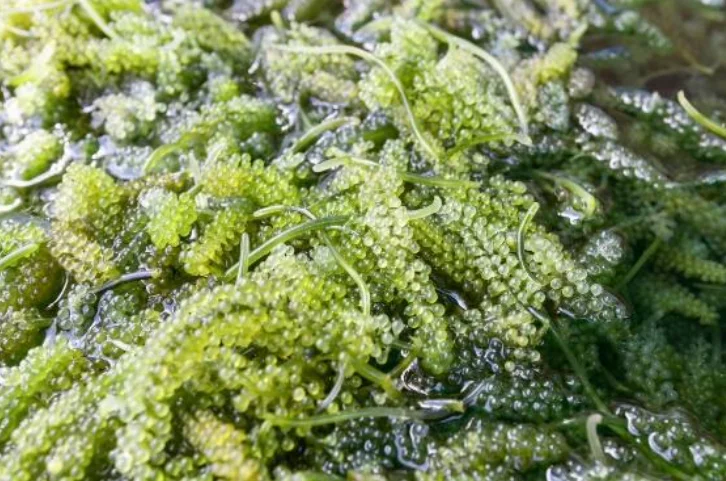
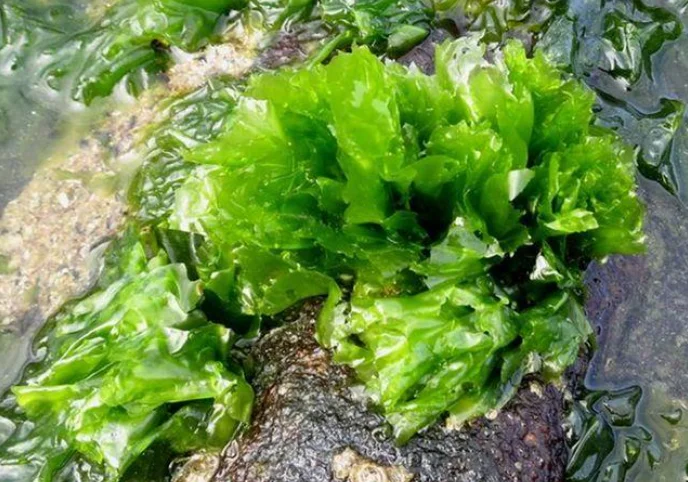
The seaweeds that are economic plants of Phetchaburi Province are Caulerpe lentillifera and Ulva rigida. Caulerpe lentillifera are green algae in the Ulvophyceae class, originating along the coast of the Indo-Pacific region. They are one of the most popular edible seaweeds because of their soft and juicy texture. It’s popular in Southeast Asia, Oceania, and East Asia. In addition, the Phetchaburi Fisheries Research and Development Center has adapted Ulva rigida from natural sources to the water system in the farm and has developed a technique for mass-scale cultivation of Ulva rigida in a simple way in canvas ponds, plastic tanks, and cement ponds. The cultivation period is only 3 weeks, and the yield is more than 3 times that of the seedlings released for cultivation. The selling price is 300-500 baht per kilogram, with a return on investment of more than 62%. Therefore, it is considered a new economic seaweed that is worth it.
WSS is interested in exploring and finding effective cultivation areas for Gracilaria fisheri. This seaweed is not popular in Phetchaburi due to a lack of knowledge and support but some farms can get G. fisheri as minor product from the cultivation of other seaweed. Here in, we propose to discuss with farmers the cultivation of G. fisheri in sustainable development under the requirements of Worldview International Foundation (WIF).
OBJECTIVES:
- 1. To meeting with Director of Phetchaburi Aquacultic Demonstration Farm and seaweed farmers.
- 2. To introduce and present Worldview Seaweed Solutions Co,.Ltd (WSS) plans and strategies.
- 3. To explore cultivation area of Gracilaria fisheri with sustainable development.
- 4. To visit and observe seaweed farm
In the visiting, we discussed about collaborated cultivation G.fisheri with farmer in Phetchaburi area under associate of Aquacultic Demonstration Director with requirement of sustainable development. Seaweed fish ball and seaweed fish cube ball were shown as starting products in Phase I and gave for sample to participants at meeting. From discussed, mostly farmers concerned about market to sell the seaweed and price. Moreover, condition of cultivation is the most topic that should be find out and studies. We might plan for sample cultivation project for study cultivation condition in basket or pond.
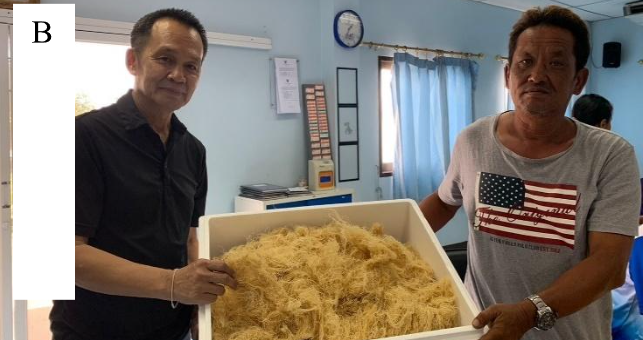
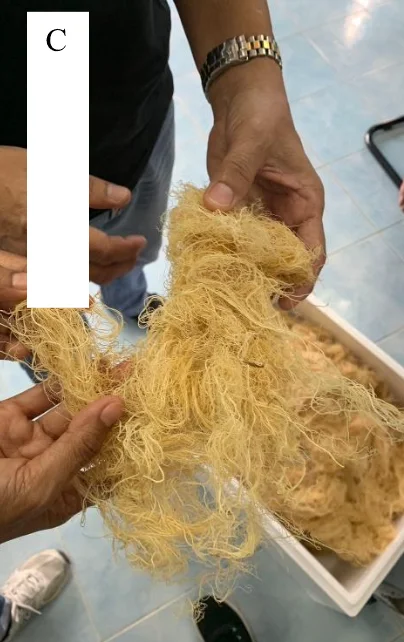
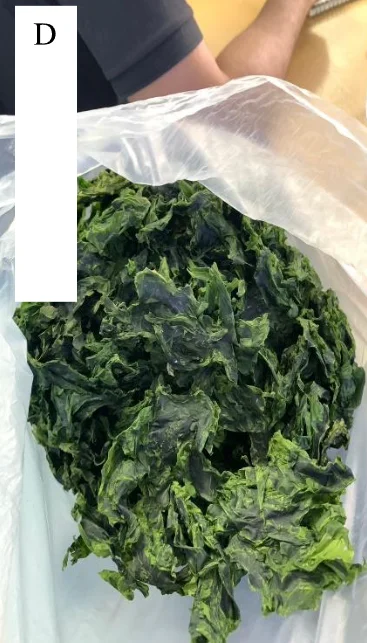
(A)Meeting and Discussing (B) Dry seaweed (G.fisheri) from K. Nirut’s farm (C) Zoom in dry seaweed (D) Dry seaweed (Ulva rigida) from Aquacuktic demoinstration
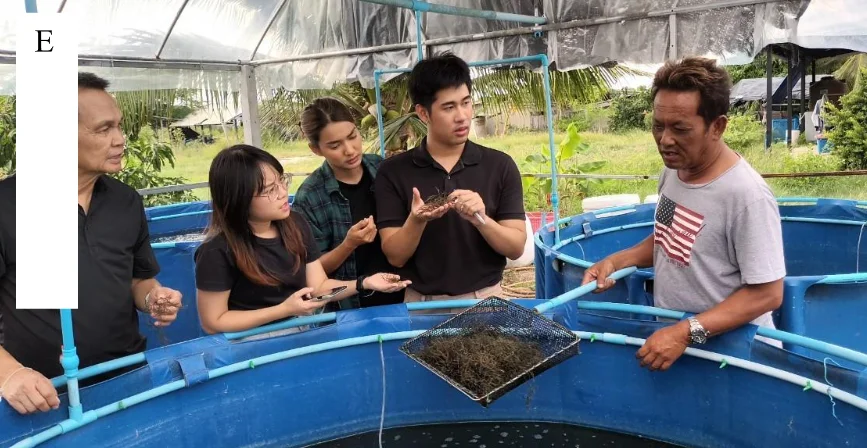
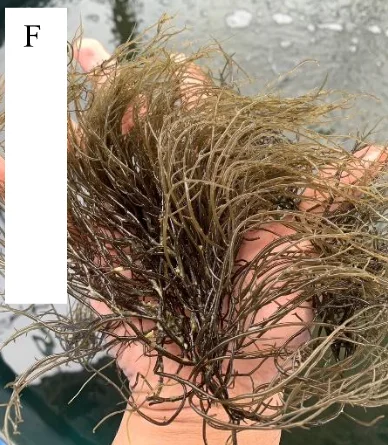
We visited K.Nirut and K.Tew farm to observed location and equipment of cultivation. At K. Nirut farm, Caulerpe lentillifera and Ulva rigida were focus as economy seaweed, all seaweeds were cultivated in plastic pond. G.fisheri was collect from nature sourcing and testing cultivate for preserve plant. We were found a little difference morphology of seaweed here (Thin and short thallus branching), then we collected some fresh G.fisheri for verify quality of seaweed compare to seaweed from Myanmar by biochemical content analysis.
(E) Discussed with K. Nirut about sourcing of G.fisheri (F) Morphology of G.fisheri in the farm
At K.Tew farm, G.fisheri were cultivated in nature pond since March 2024 without maintenance. G.fisheri was collected to observed. It was found that, seaweed mostly die and dirty.
(G) Farmer collecting seaweed in the pond for observation. (H) Morphology of seaweed from K.Tew farm
Phetchaburi is the one province that has the potential for cultivation G.fisheri due to environment and basic knowledge of farmer in seaweed cultivation. The important topics that need to study are condition for cultivation G. fisheri in nature pond and sustainable materials.
BLOG & NEWS
Content Gates of persia für echtes Geld: Vierter Schritttempo: Auftreiben Die leser Ihren Freispiel-Slot ferner spielen Eltern Wafer Vorteile hat ihr Verbunden Kasino Maklercourtage abzüglich Einzahlung? Online Spielsaal Prämie exklusive…
Kuinka valita nettikasino, joka sopii sinulle? Monet pelaajat arvostavat mahdollisuutta osallistua erilaisiin kampanjoihin. Nettikasinot järjestävät usein kilpailuja ja arvontoja, joissa pelaajat voivat voittaa hienoja palkintoja. Tämä lisää jännitystä ja kilpailuhenkeä…
When you’re in a hurry, you need a casino that keeps up with your pace—no long loading screens, no endless menus, just instant access to games that deliver fast results….
Now that you have all you need to begin to try out to own free, select one of one’s necessary FairPari official website Canadian brands and you will allow the…
Έχω δοκιμάσει σε πολλά διαδικτυακά καζίνο ως Έλληνας παίκτης. Το Mafia Casino δεν είναι μόνο ένα ακόμη. Είναι το κύριο μου σημείο για διασκέδαση. Αυτό το καζίνο καταλαβαίνει πραγματικά τι…
Of several on the web roulette simulators utilize the European controls as his or her standard alternative When you are fresh to the video game, can gamble roulette on line…

We are part of a global environmental organization. The organization was established to support local communities in protecting and preserving mangrove ecosystems by providing livelihood support, knowledge on cultivation techniques, and establishing seaweed farms. The goal is to foster a sustainable community-based blue economy.